

Verifying a real family emergency call before you wire money
A cloned voice can sound urgent and familiar. The safest move is to stop the rush and verify the story on a second channel before any money leaves your account.
Key takeaways
- A familiar voice is no longer proof by itself.
- End the first call and verify on a second channel you already trust.
- Do not send money, share details, or keep secrets during the first contact.
- Use your saved contacts or an existing family chat, not the number the caller gives you.
- Public family details on social media can make emergency scams more convincing.
- Report scam attempts and warn relatives so the attacker cannot reuse the same story.
Why this matters to you
Your 2-minute quick win
Save one family verification rule in your phone notes now: if a caller says there is an emergency and asks for money, end the call and contact that person, or another close relative, on a number you already trust. Success looks simple. You do not stay on the line. You do not wire money during the first call. You make one separate call or message from your own contacts list before doing anything else.
A family emergency scam is built to make you skip that one check. The caller wants fear, speed, and secrecy. A cloned voice adds pressure because it may sound like someone you love.
The source material explains why this feels convincing. The German BSI says manipulated voices can be created with AI through 'Text-to-Speech' and 'Voice Conversion' methods. It also says these methods can be used for social engineering and fraud, including calls that push someone to trigger a money transfer.
The same source warns that deepfake methods can mislead both people and automated speaker recognition. That matters because a familiar voice is no longer proof by itself. It is now only one clue.
The UK NCSC explains that scams can arrive by phone call, text, email, or website. Criminals use personal information found online, including on social media, to make messages feel real. In a family scam, that may mean they know names, travel plans, or a recent hospital visit.
This guide is not about becoming a forensic expert. It is about using a calm routine that works even when you are shocked. If you can remember stop, hang up, verify elsewhere, you are already much harder to trick.
Why cloned-voice calls are so effective
Voice carries emotion fast. You hear stress, crying, or a shaky tone, and your brain fills in the rest. That can push you to act before you think.
BSI notes that high-quality fakes are easier to create than they used to be. It also notes that only a few minutes of source audio may be enough in some cases, though quality can vary. That means short public clips on social media can still help an attacker.
The NCSC adds another reason these scams work. Attackers study what people post online and use it to sound credible. Even a basic detail, like where a grandchild studies or which city a cousin lives in, can make the story land.
What you are protecting
You are protecting your money first. A rushed bank transfer can be hard to reverse, especially if it goes out quickly.
You are also protecting your judgment. Once a scammer gets you to obey one urgent request, they often try a second one. That could be more money, more personal details, or a request to keep the event secret from the rest of the family.
You are protecting your family network. If one person pays, the attacker may call others next with a stronger story. They can say a parent already helped, or that only one final transfer is missing.
You are protecting personal information as well. The NCSC says phishing aims to steal bank details or other personal information. A fake emergency can do the same by asking for birth dates, account details, addresses, or identity documents.
You are also protecting trust in your usual channels. BSI says deepfake methods can be used to support targeted social engineering. Once people learn that a familiar voice can be faked, families need a better proof method than sound alone.
What counts as good proof
Good proof comes from a second channel you control. Call back using a number already saved in your contacts. Send a message in an existing family chat. Call another close relative who can physically reach the person. These are general safety steps, but they are powerful because the attacker does not control them.
Bad proof is anything that stays inside the attacker's story. That includes staying on the same call, calling back a number the caller gives you, or sending money to buy time while you keep checking. If the first contact is fake, those actions keep you inside the trap.
What it costs you if you skip this
The direct cost is money sent to a criminal. The BSI source gives a clear fraud pattern: a caller can use the voice of a trusted authority to trigger a money transfer. A family scam uses the same pressure, only with a loved one instead of a boss.
The second cost is more data loss. If you stay engaged, the caller can keep gathering details. They may ask for full names, home address, date of birth, bank name, or which relative can send the most money fastest.
The third cost is emotional harm. People who fall for emergency scams often feel shame because the request seemed personal. That shame can delay reporting, which gives the attacker more time to try again.
There is also a wider cost. The NCSC says reporting suspicious messages and websites helps reduce scam communications, makes you a harder target, and protects others. The same logic applies to scam calls. A fast report helps investigators spot patterns and remove related infrastructure when possible.
Skipping verification also teaches the attacker your family is responsive. If they learn that panic works, they may return with new calls, texts, or fake websites linked to the same story.
Step by step
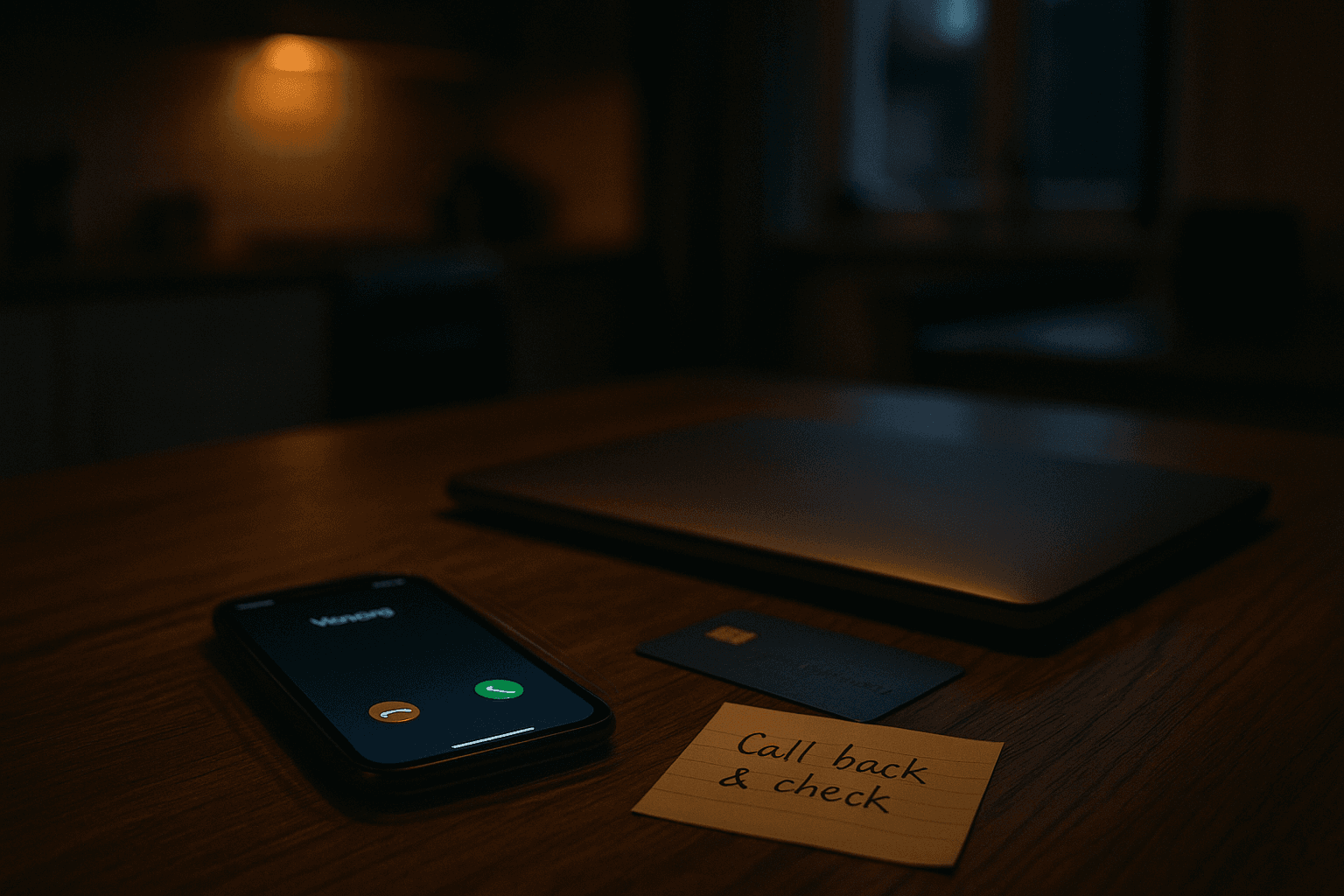
End the first call. Say: ‘I’m going to call you back on the number I already have.’ Then hang up. Done correctly looks like the call screen closing and you being off the line, not still listening while the caller keeps talking.
Open your contacts list, not the recent caller screen. Use the number already saved for that family member, or for another close relative. Done correctly looks like you choosing a known contact from your phone book, not tapping the number the caller used.
Try a second channel you control. Send a message in an existing family chat, or place a normal call to another trusted relative. Done correctly looks like a message sent to people you already know, in a thread that existed before the emergency story started.
Ask one question that needs shared context. Keep it simple and specific, such as where you last met, who drove last Sunday, or which family member hosted the last birthday meal. Done correctly looks like a clear, immediate answer that fits what you already know, not a dodge or a demand to hurry.
Listen for warning signs named by BSI. Notice if the voice sounds metallic, oddly monotone, badly pronounced, delayed, or unlike the person’s normal way of stressing words. Done correctly looks like you treating those clues as reasons to verify more, not as proof either way.
Refuse pressure and secrecy. If the caller says do not tell anyone, or says money must leave now, stop the conversation. Done correctly looks like no payment started and no banking app opened during the call.
Do not use speaker recognition as your proof. BSI warns that manipulated voices may deceive people and automated speaker recognition systems. Done correctly looks like you relying on a trusted callback path, not on how familiar the voice sounds.
Check your social media exposure after the event. Review what family details are public, because the NCSC says criminals use online information to make scams more convincing. Done correctly looks like fewer visible details about names, travel, school, and routine.
Report the scam attempt. If you are in the UK, use the NCSC reporting pages for scam phone calls and related phishing content. Done correctly looks like the report submitted with the phone number, time, and any text or website the caller sent.
Warn the family in one message. Tell them what number called, what story was used, and that nobody should send money without a separate callback. Done correctly looks like one clear family alert that gives everyone the same rule.
A simple script that helps
If you freeze under pressure, use one short line every time: ‘I’m ending this call and calling back on a number I already trust.’ It is polite, clear, and hard for a scammer to work around. It also buys you the few seconds you need to think.
Illustrative example
Marie is 67 and lives alone in Lyon. One afternoon, her phone rings from an unknown number. She hears what sounds like her grandson Leo. The voice is upset. It says there has been an accident, a phone was lost, and money is needed now for urgent help.
For a moment, Marie believes it. The voice sounds familiar enough. It uses Leo’s name, and it knows he was travelling this week. Then Marie remembers the family rule in her notes.
She says, ‘I’m going to call you back on the number I already have.’ The caller tries to stop her. He says there is no time. He says not to tell Leo’s parents yet. Marie hangs up anyway.
She opens her contacts list and taps Leo’s saved number. No answer. She then sends a message in the family chat that already exists on her phone: ‘I had an emergency call from someone claiming to be Leo. Please reply now.’
Within a minute, Leo’s mother answers in the chat. Leo is on a train, not in hospital. A few minutes later, Leo replies from his real number. He is safe. His voice note sounds normal, but Marie does not need that as proof now. She already verified through trusted contacts.
Marie writes down the calling number, the time, and the exact request for money. She keeps the text message the caller sent with bank details. She reports the attempt and tells the wider family not to act on any similar calls.
The outcome is plain. No money leaves her account. The attacker loses control the moment Marie moves the conversation to a separate channel.
The near-miss
Now replay the same call with one step skipped. Marie stays on the line because the voice is crying and sounds like Leo. The caller says the transfer must happen in minutes. He tells her not to ring anyone else because it will make things worse.
Marie opens her banking app while still speaking to him. Because she never leaves the attacker’s story, every new sentence increases the pressure. She reads out a transfer limit and asks how much is needed.
At that point, the scam has almost succeeded. The voice did not need to be perfect. It only needed to keep her from using her own contacts list and family chat. The skipped callback is the whole opening.
How to check it worked
Your process worked if you did three things in order. You ended the first contact. You used a second channel you already trusted. You delayed any payment until a real relative confirmed the facts.
You should also have a small record of the attempt. That can be the incoming number, the time of the call, and screenshots of any text or website the caller sent. This helps when you report it and helps your family recognise repeat attempts.
Another sign it worked is emotional, not technical. After the call, you can explain the story in a calm sentence. If you still feel pushed to act immediately, pause longer and hand the situation to another relative before taking any financial step.
Look at your online footprint too. The NCSC advises reviewing privacy settings and thinking about what personal information you and others post. If you remove easy clues about family names, travel, school, and routines, future scam stories become harder to script.
Test yourself
Question: What is the safest first move when a relative asks for urgent money on a call?
Answer: End the call and contact them, or another close relative, on a number you already trust.
Question: Why is a familiar voice not enough proof on its own?
Answer: BSI says AI methods can create manipulated voices that may deceive both people and speaker recognition systems.
Question: What family details should you avoid sharing widely online?
Answer: Avoid making names, travel, school, and daily routine details easy for strangers to gather.
Common mistakes
Staying on the line to be polite. Politeness gives the attacker time. The safe move is to end the call and verify elsewhere.
Calling back the number the caller provides. That keeps you inside the same setup. Use only numbers already saved or independently known to you.
Trusting the sound of the voice alone. BSI explains that synthetic voices can sound like a target person. Familiar tone is not enough proof anymore.
Letting urgency cancel the family rule. The entire scam depends on speed. If the caller says act first and check later, that is a warning sign.
Sharing too much family detail publicly. The NCSC says criminals use social media information to make scams convincing. Small details can make a false story feel personal.
Ignoring odd audio clues. A metallic sound, monotone delivery, wrong stress, strange pronunciation, or a delay should make you slow down. These are not perfect detection methods, but they are useful prompts to verify.
Failing to warn others after the attempt. If one person was targeted, another may be next. A short family alert can break the attacker’s plan.
Level up
Create one standing family code check this week. Agree that any urgent request for money must be confirmed by a separate callback and one shared-context question that only close relatives can answer. This is simple, free, and effective because it does not depend on whether a voice sounds real.
You can strengthen it further with one privacy habit from the NCSC guidance. Review your social media privacy settings and ask family members to do the same, so scammers have fewer details to build a believable emergency story.
For deeper background on how deepfake audio works and which warning signs can appear, read the BSI overview on deepfakes. For general scam reporting and advice on suspicious calls, texts, emails, and websites, use the NCSC phishing guidance.
Checklist
- Save a short callback rule in your phone notes.
- Use your contacts list, not the recent caller number, to verify.
- Ask one simple shared-context question before discussing money.
- Never send funds during the first emergency call.
- Keep the number, time, and any messages for reporting.
- Review family social media privacy and reduce public details.
Frequently asked questions
Can I trust a voice note if it sounds exactly like my relative?
No. BSI explains that AI methods such as Text-to-Speech and Voice Conversion can create manipulated voices, so you still need a separate callback or message on a trusted channel.
What if the real family member does not answer right away?
Do not send money to buy time. Contact another close relative through your saved contacts or an existing family chat and keep verifying until someone independently confirms the story.
Are strange audio clues enough to prove a scam?
Not on their own. BSI lists clues like metallic sound, monotone speech, bad pronunciation, unusual emphasis, and delay, but the safest action is still to verify on another channel.
Why do scammers know personal family details?
The NCSC says criminals use information available online, including social media posts, to make scam messages and calls more convincing.
Sources
Stay Updated
Subscribe to our newsletter for the latest cybersecurity insights, threat intelligence, and security best practices.